
Lamphun’s temples offer a profound introduction to the spiritual heart of this historic northern province. More than places of worship, they are living cultural spaces where centuries of faith, artistic skill, and local tradition continue to shape the daily lives of the community. Their grounds often reveal a graceful blend of architectural influences, reflecting the long passage of time from earlier regional kingdoms to the distinctive elegance of the Lanna period. Visitors can admire beautifully proportioned chedis, intricately decorated viharns, ancient Buddha images, wooden structures, murals, and sacred objects that demonstrate the devotion and craftsmanship of generations past. The quiet atmosphere within these temple compounds provides a welcome opportunity to slow down, observe local customs, and appreciate the role that Buddhism continues to play in the identity of Lamphun. Early in the morning, the sound of temple bells and the sight of residents making merit create a peaceful scene, while festivals and important religious days bring the same spaces to life with candles, flowers, offerings, processions, and traditional celebrations. Many temples are also closely connected to local legends, revered historical figures, and stories that have been passed down through generations, giving each place its own character and significance. For visitors, exploring Lamphun’s temples is not simply a journey through beautiful architecture or ancient history; it is an opportunity to experience the enduring relationship between spirituality, community, art, and heritage that has made Lamphun one of northern Thailand’s most culturally meaningful destinations. The province’s rich Hariphunchai and Lanna heritage remains visible in its sacred places and cultural landmarks.
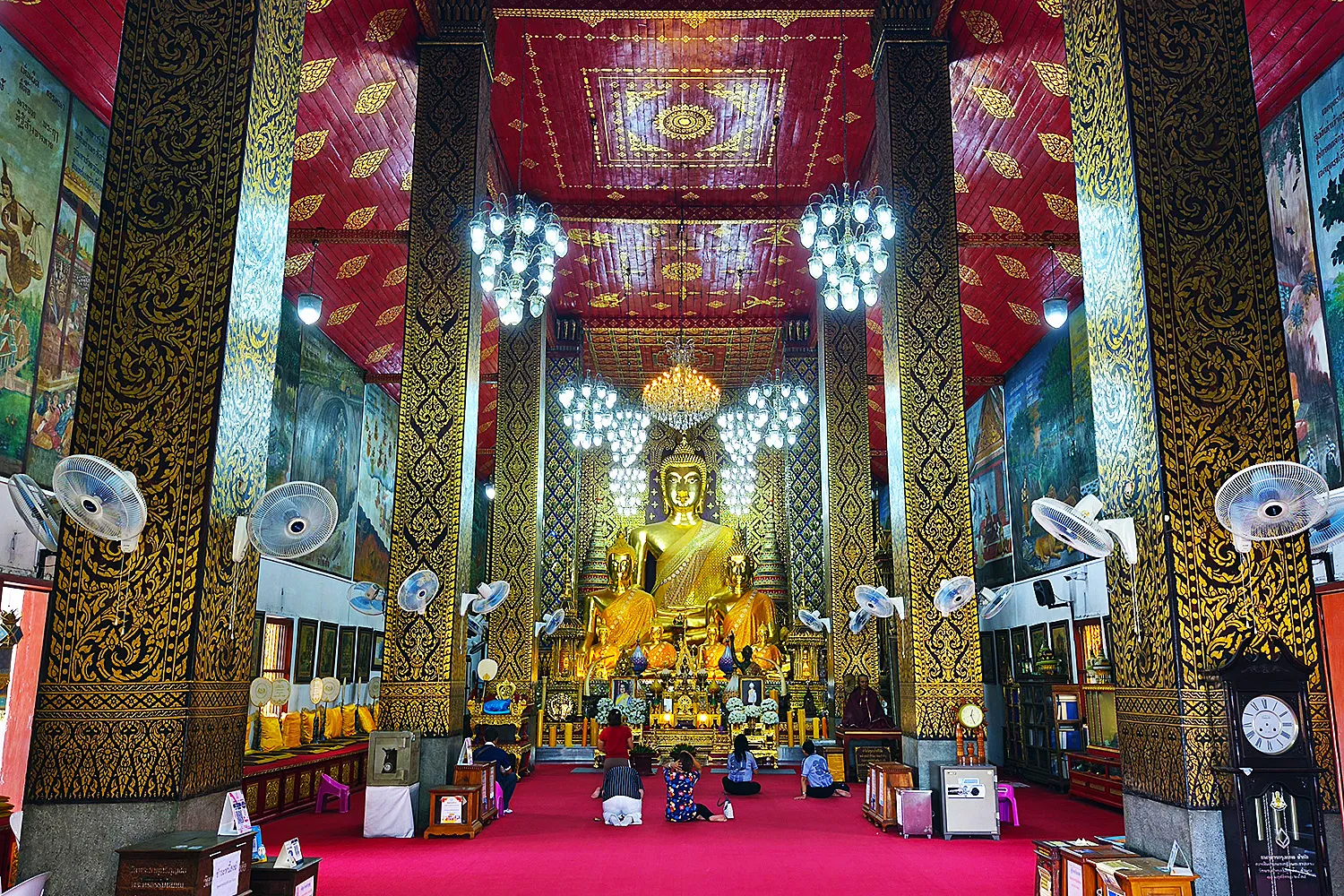
Wat Phra That Hariphunchai Woramahawihan:
Situated in the heart of Lamphun province, Thailand, Wat Phra That Hariphunchai Woramahawihan stands as a revered and sacred monument, representing centuries of spiritual significance and historical legacy. This ancient temple holds a special place in the hearts of locals and draws in countless visitors seeking spiritual solace and cultural admiration. With roots dating back over a millennium, Wat Phra That Hariphunchai Woramahawihan is steeped in rich history. The grandeur of Wat Phra That Hariphunchai Woramahawihan is immediately apparent upon first sight. As visitors approach the temple, they are met with a magnificent chedi (stupa) that stands tall and resplendent, adorned with intricate golden details. This stupa is believed to enshrine relics of Lord Buddha, making it an object of great veneration for Buddhist devotees. The temple’s architecture reflects a harmonious blend of Lanna, Mon, and Hariphunchai styles, showcasing the diverse cultural influences that have shaped the region throughout its history. Elaborate carvings, ornate decorations, and beautifully crafted statues adorn the temple grounds, creating an atmosphere of awe and reverence. Apart from its religious significance, Wat Phra That Hariphunchai Woramahawihan plays a vital role in preserving and promoting the cultural heritage of Lamphun. Numerous religious festivals and cultural events are celebrated within the temple’s premises, providing a glimpse into the vibrant traditions of the region. For travelers seeking to delve deeper into the spiritual and historical tapestry of Lamphun, a visit to Wat Phra That Hariphunchai Woramahawihan is an absolute must. Immerse yourself in the sacred atmosphere, appreciate the architectural splendor, and pay homage to the centuries-old relics that hold profound spiritual value. Witness the timeless beauty and enduring legacy of this sacred treasure, as it continues to be a beacon of faith and cultural pride in Lamphun.

Wat San Pa Yang Luang Temple:
Among the many captivating temples in Thailand, Wat San Pa Yang Luang stands out as a true gem, renowned for its exquisite stucco carvings that beautifully blend the essence of traditional and contemporary Lanna art. Located at 113 San Pa Yang Road, Soi 10, in Mueang Lamphun District, Lamphun Province, this remarkable temple serves as a testament to the region’s rich cultural and artistic heritage. One of the temple’s most distinctive features is the intricate stucco work adorning the Viharn Phra Khong Khiew. These masterfully crafted carvings showcase a seamless fusion of classical Lanna artistry and modern influences, resulting in breathtaking designs that captivate all who visit. Every detail reflects exceptional craftsmanship, from the ornate gable decorations and elaborately decorated ceilings to the beautifully embellished pillars. The temple’s doors and windows are equally impressive, featuring lacquered patterns and gilded motifs that further enhance the grandeur of the viharn. Inside the viharn stands Phra Phuttha Anyaratana Mahanat Si Hariphunchai, also known as Phra Khiaw Khong, a revered Buddha image of great spiritual significance. This magnificent image was skillfully carved from stones sourced from the sacred Mekong River, making it both an artistic and religious treasure. Wat San Pa Yang Luang is a remarkable destination that continues to captivate the hearts of devotees and visitors alike. Its extraordinary beauty, intricate craftsmanship, and profound spiritual atmosphere make it a must-visit attraction for anyone traveling to Lamphun Province. As you explore this enchanting temple, you will be immersed in a world where art, history, and spirituality harmoniously intertwine, leaving you with lasting memories and a deep appreciation for the timeless beauty of Thai architecture.
Wat Chamathewi Temple:
Wat Chamathewi Temple, commonly known as Wat Ku Kut, is a significant ancient temple situated on Chamadevi Road in Nai Mueang Sub District, Lamphun Province. Dating back to the Lanna Thai period, this revered site holds immense historical and archaeological importance. According to inscriptions found at the temple, it is believed that Queen Chamathewi’s son, Chao Mahantayot, and Chao Anantayot commissioned its construction as a royal cremation site. They ordered the creation of a square pagoda with a gold-covered top, known as Suwanna Jangkoti. This pagoda, also referred to as Phra Chedi Chamathewi, was inspired by the architectural style of Buddha Gaya in India. Each of its four sides features niches housing standing Buddha images in a blessing posture—15 images per level, totaling 60. Within the pagoda rests the ashes of Queen Chamathewi, the first ruler of Hariphunchai. Over time, the pagoda’s top broke off, leading locals to nickname it Ku Kut Pagoda, though its official title remains Phra Chedi Suwanna Jangkoti. This structure is regarded as an exemplary representation of Hariphunchai artistic style. Another remarkable feature of the temple is its octagonal pagoda, an intricately designed structure with a tiered, stacked formation. This architectural masterpiece can be divided into three sections: the base, consisting of two stacked octagonal layers; the lotus tier that supports the chedi; and the upper portion, which rises in a tall octagonal shape. Inside, a standing Buddha image resides within a niche framed by three curved circles. Wat Chamathewi is deeply revered by Buddhists and remains one of Thailand’s most significant historical and archaeological sites, attracting visitors eager to explore its sacred and artistic legacy.
Wat Phra Phutthabat Tak Pha Temple:
Nestled in the serene landscapes of Lamphun Province, Wat Phra Phutthabat Tak Pha is a revered Buddhist temple with deep historical and spiritual significance. Located in the Makok Sub District of Pa Sang District, this temple is known for its connection to ancient Buddhist legends and its breathtaking architecture. According to local beliefs, the Lord Buddha once visited this site during his travels. It is said that he left his footprint on a rock, which is now enshrined within the temple. Additionally, legend has it that Buddha’s saffron robe was laid out to dry on the rocks, leaving an imprint that remains visible today. This unique story gives the temple its name, as “Tak Pha” means “hang out to dry”. Wat Phra Phutthabat Tak Pha is built on two levels, separated by a 469-step staircase adorned with five-headed naga serpents. Visitors can either climb the steep stairway or take a road leading to the upper level. The temple’s golden pagoda, dedicated to four revered monks, stands majestically at the summit, offering panoramic views of the surrounding countryside. The temple is an important pilgrimage site for Buddhists, who come to pay respects to the Buddha’s footprint and witness the imprint of his robe. The lower level of the temple also features a small cave housing sacred images of worship. Every year, a special festival is held to bathe the footprints, attracting devotees from across Thailand. For those exploring Lamphun or Chiang Mai, this temple is a must-visit destination. It offers a blend of spiritual tranquility, historical intrigue, and architectural splendor. Whether you seek a peaceful retreat or a cultural experience, Wat Phra Phutthabat Tak Pha promises an unforgettable journey into Thailand’s rich Buddhist heritage.
Wat Chang Rong Temple:
Wat Chang Rong, also known by some as “Wat Chang Rong,” is a small yet historic temple with a distinctive charm and a story of its own. It is located in the Tha Nang area of Lamphun, not far from Wat Phra That Hariphunchai Woramahawihan. With its peaceful, shaded atmosphere and proximity to the Kuang River, the temple is an ideal place for visitors wishing to pay their respects, admire Buddhist art and architecture, and experience a tranquil corner of the ancient city of Hariphunchai. The temple’s name is associated with the legend of Queen Chamathewi. According to local tradition, this area was once where the royal elephant named “Pu Kam Nga Khiao” was brought to bathe in the Kuang River. It is said that the elephant let out a cry there, giving rise to the name Wat Chang Rong, or Wat Chang Rong, in local belief. This legend connects the temple closely with the history and folklore of Hariphunchai, echoes of which can still be found at important sites throughout Lamphun. Within the temple grounds are Buddhist structures and artistic features that invite visitors to explore at a leisurely pace. Although it is not as large or grand as some of Lamphun’s more prominent temples, the beauty of its architectural details and the simplicity of its surroundings create a memorable and welcoming atmosphere. Visitors may pay homage to the principal Buddha image, stroll around the temple grounds, and learn about the long-standing relationship between the temple, the riverside community along the Kuang River, and the ancient legends of Lamphun. Wat Chang Rong is a reminder that Lamphun’s tourism extends beyond its major historical monuments. The city is also home to small temples that preserve local history, faith, and collective memory in meaningful ways. For those interested in Lanna culture and eager to discover the quiet charm of an ancient city, Wat Chang Rong is well worth a visit. It can be reached easily from Wat Phra That Hariphunchai by following the Kuang River for a short distance.
Wat Mahawan Temple:
Wat Mahawan, also known as Wat Mahawan Wanaram, is an ancient royal temple in Lamphun. Located on Chamathewi Road in Mueang Lamphun District, it has long been closely associated with the history of the ancient city of Hariphunchai. According to legend, the temple was established during the reign of Queen Chamathewi after she ascended the throne of Hariphunchai, serving as a centre of faith and Buddhist propagation. It is therefore regarded as one of the city’s most important temples, clearly reflecting Lamphun’s cultural roots and past prosperity. Wat Mahawan is widely renowned for Phra Rod Lamphun, a celebrated ancient clay amulet. It is honoured as one of the Benjapakhi, or the Five Great Amulets of Thailand, and is deeply revered by Buddhist devotees and amulet collectors alike. Phra Rod Mahawan is closely linked to the temple’s chedi crypt and is recognised as an important prototype of the Lamphun Phra Rod tradition. In popular belief, the amulet represents protection, safety, escape from danger, loving-kindness, popularity, and auspiciousness. As a result, devotees and collectors continue to visit the temple to pay homage, make merit, and seek blessings. Local accounts tell of Phra Rod and Phra Khong being created by a learned hermit to inspire and encourage the people during a time when Hariphunchai faced the threat of war. The two amulets therefore carry a symbolic meaning of protection for the city. Phra Khong was said to have been enshrined at Wat Phra Khong Ruesi, while Phra Rod was placed at Wat Mahawan. Although these accounts have been passed down as legend, they reflect the enduring faith, hope, and bond that local people have shared with the temple and their sacred objects across generations. Beyond its association with Phra Rod, Wat Mahawan also features beautiful Lanna-style architecture. Within the temple grounds are a gleaming golden chedi, an ordination hall, a viharn, a sermon hall, monks’ residences, a bell tower, and a scripture library, as well as the principal Buddha image and other revered religious objects, all carefully preserved. The temple’s peaceful and shaded setting is ideal for appreciating its artistic heritage, making merit, or reflecting on the history of Hariphunchai through a place that remains a living spiritual centre for the community. For visitors to Lamphun, Wat Mahawan is more than an ancient temple worthy of worship. It is a place where history, legend, art, and faith are gracefully intertwined. A visit offers a deeper appreciation of the importance of Buddhism and the Hariphunchai heritage that continues to be preserved and passed on to the present day.
Wat Phra Yuen Temple:
Wat Phra Yuen is an ancient temple of considerable historical importance in Lamphun. It is located in Wiang Yong Subdistrict, Mueang Lamphun District, on the eastern side of the Kuang River. The temple takes its name from the Phra Yuen, or standing Buddha image, which is its principal sacred object and has long served as a focus of faith for Buddhist devotees. According to local legend, the temple is connected to the early period of the ancient city of Hariphunchai, making it an important site for understanding both the city’s former prosperity and the enduring presence of Buddhism in Lamphun. The temple’s most distinctive feature is Phra Yuen Chedi, which displays architectural characteristics influenced by the Pagan style of Myanmar. The chedi stands on a tall, tiered base, with an upper circumambulatory terrace and small subsidiary chedis positioned at each of the four corners. Its central structure is square in form, with projecting niches on all four sides, rising to a graceful bell-shaped spire. This elegant design sets Phra Yuen Chedi apart from other chedis in Lamphun and reflects historical artistic connections between the Lanna region and Pagan. Enshrined within the chedi is the temple’s principal standing Buddha image. Temple records state that it was created in 1063 CE during the reign of King Dhammikaraja. Cast in bronze, the image measures 18 sok, or approximately 9 metres in height. A chedi was later built to encase the image, while smaller standing Buddha images were installed on all four sides of the structure. This allows visitors to pay homage to the standing Buddha images from outside while admiring the refined architectural details of the chedi. In addition to Phra Yuen Chedi, the temple’s ordination hall is also noteworthy. Its pediment and exterior side walls feature mural paintings created during a major restoration in 1929. These paintings add artistic value to the temple and reflect the skills of local artisans, as well as the religious beliefs passed down through different periods. The temple also contains stone inscriptions and other religious structures worthy of study. A visit to Wat Phra Yuen is therefore not only an opportunity to worship and seek blessings, but also to explore Lamphun’s history, art, and culture at close range. With its peaceful, shaded surroundings and the beauty of its Buddhist art, Wat Phra Yuen is an ideal destination for those wishing to pay respect to sacred objects, appreciate ancient architecture, and experience the living heritage of Hariphunchai that remains deeply woven into Lamphun’s way of life today.
Wat Phra Khong Ruesi Temple:
Wat Phra Khong Ruesi, originally known as Wat Appat Tharam, is an ancient and highly respected temple associated with the early history of the Hariphunchai Kingdom. According to local tradition, it was established during the reign of Queen Chamathewi as a place of residence, meditation, and Buddhist practice for monks who had travelled from Lungkawi. With its long spiritual heritage and connection to the development of Buddhism in Lamphun, the temple remains an important place of worship for local people and visitors alike. The temple is especially well known for its association with Phra Khong, one of Lamphun’s most famous and revered ancient amulets. Wat Phra Khong Ruesi is traditionally recognised as one of the four temples located at the corners of the old city, each of which played an important role in protecting and supporting the ancient settlement. Local beliefs link the creation of the Phra Khong amulets to the hermits Vasudeva Ruesi and Sukkanta Ruesi, who are said to have founded or supported the establishment of the temple. This connection is believed to be the origin of the name “Wat Phra Khong Ruesi,” meaning the Temple of Phra Khong and the Hermits. Visitors come to Wat Phra Khong Ruesi to pay respect, make merit, and seek blessings for prosperity, well-being, and protection. The temple is located in Mueang Lamphun District and provides a peaceful setting for those interested in Buddhist art, local legends, and the cultural heritage of the old Hariphunchai city. Each year, following the Songkran Festival, local residents take part in a traditional ceremony of worship and water-pouring for the sacred chedi. This meaningful annual practice reflects the community’s continuing faith and its deep respect for the temple’s religious and historical importance.